The 3,000-Year-Old Hymn That Admits No One Knows How the Universe Began
Explore the Nasadiya Sukta, a 3,000-year-old Vedic hymn that dares to question creation itself. Discover why embracing uncertainty may be the deepest form of wisdom.
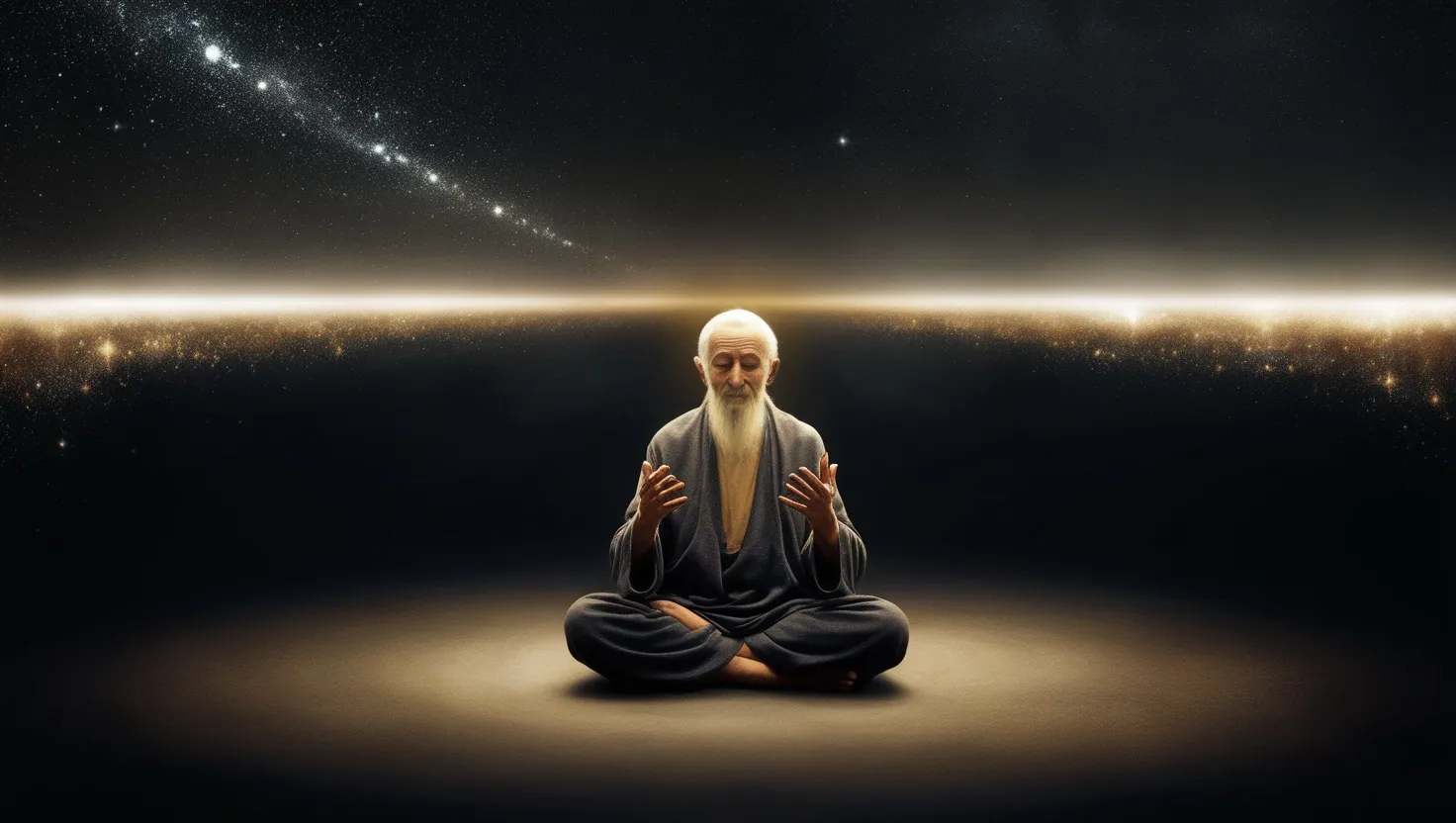
There is a hymn so old, so strange, and so honest that even after thousands of years it still stops you in your tracks. It does not tell you how the world was made. It does not give you a god to thank or a myth to believe. Instead, it asks a question and then admits it does not know the answer. That hymn is the Nasadiya Sukta, found in the tenth book of the Rigveda, and it may be the most intellectually courageous piece of writing in all of human history.
Most ancient texts about creation are confident. They say: in the beginning, God made this. Or: the universe emerged from an egg, a word, a breath. The Nasadiya Sukta does something completely different. It says: before creation, there was neither existence nor non-existence. No air, no sky, no death, no immortality, no day, no night. Just one thing, breathing without breath, resting within itself. And then it asks — so who actually knows what happened next?
Think about that for a second. A poet sitting in ancient India, possibly three thousand years ago or more, looked at the biggest question a human being can ask — where did all of this come from? — and instead of making something up, they wrote down their honest confusion. That is not a small thing.
“The most beautiful thing we can experience is the mysterious. It is the source of all true art and science.” — Albert Einstein
The opening lines of the hymn use language that deliberately breaks your brain. It says there was neither being nor non-being. Now, your mind immediately wants to ask: okay, but what was there then? And the hymn answers: exactly. You cannot say. The moment you try to describe what existed before existence, every word you use assumes the very thing you are trying to describe. Language itself collapses. The seer knew this, and that is why the hymn is written the way it is — in paradoxes on purpose.
This method has a name in philosophy. It is called apophatic thinking, or the via negativa — describing something by saying what it is not. You cannot say what the ultimate source is. You can only say it is not this, not that, not anything you can name. The Upanishads would later use this method constantly, especially in phrases like “neti, neti” — not this, not this. But the Nasadiya Sukta does it first, and does it beautifully.
What did the universe come from? Have you ever sat with that question long enough to feel genuinely dizzy?
Here is what most people do not realize about this hymn. It does not treat uncertainty as a failure. It treats uncertainty as the appropriate, honest response to the biggest question there is. The gods themselves, the hymn points out, came after creation. So even the divine beings cannot be witnesses to the origin. They arrived late to the party, just like we did. The idea that even gods are limited in their knowledge — that is radical. That is genuinely unusual in any religious tradition.
“Ignorance more frequently begets confidence than does knowledge.” — Charles Darwin
Then comes the line that has been quietly stunning readers for millennia. The hymn ends by saying: maybe the one from whom this creation came knows — or maybe even it does not know. Read that again. The source of all existence might not know how it created everything. The poet is not being sarcastic or poetic for the sake of it. They are pointing at something real — the possibility that origin is genuinely unknowable, even from the inside.
Now think about what modern physics does at the edge of its own knowledge. When scientists trace the universe back to the Big Bang, everything works fine until they reach the singularity — that first point of infinite density and zero size. At that point, all their equations break down. Their models simply stop working. They cannot say what came before it, or even if the word “before” means anything without time. The Nasadiya Sukta described this exact wall of knowledge three thousand years before anyone built a telescope.
This is not coincidence. It is a sign that certain kinds of very deep, very honest thinking tend to arrive at the same edges, regardless of the tools used to get there.
“We shall not cease from exploration, and the end of all our exploring will be to arrive where we started and know the place for the first time.” — T.S. Eliot
One of the most interesting things in the hymn is the appearance of desire. The seer says that in the beginning, desire arose — and that desire was the first seed of mind. This is extraordinary. Most people assume that matter comes first and mind comes later. The universe makes rocks, rocks make planets, planets make life, life makes brains, brains make thoughts. But the Nasadiya Sukta reverses this. It says the first thing that moved was something like will, or want, or intention. Consciousness was not a late arrival. It was the starting point.
This idea sounds wild until you notice that some of the most serious thinkers in quantum physics — including people like John Wheeler — began suggesting something similar. Wheeler proposed that the universe is not just observed by conscious beings but that consciousness may be built into the structure of reality itself. He even coined the term “participatory universe” for this idea. The Vedic seer beat him to it by a few thousand years.
What does it mean to you personally if the universe started with something like desire or awareness rather than with a lump of matter?
Here is something else worth sitting with. The Nasadiya Sukta is not a fringe text hidden in some obscure corner of the Vedas. It is one of the most celebrated hymns in the entire collection. Which means the culture that produced it was not embarrassed by uncertainty. They elevated it. They made not-knowing into something sacred. That says something important about how they thought about wisdom. Wisdom was not the possession of all the answers. Wisdom was knowing the shape and size of what you did not know.
Compare this to the pressure most of us feel today. We are expected to have opinions about everything, to be certain, to project confidence. Admitting you do not know is often treated as weakness. The Nasadiya Sukta comes from a tradition that thought the exact opposite. To sit with a real question and refuse to fake an answer — that was considered a mark of genuine intelligence.
“The only true wisdom is in knowing you know nothing.” — Socrates
This has practical consequences for how you live. When you are confronted with something genuinely ambiguous — a difficult decision, a moral question without a clean answer, a personal mystery about who you are or what you want — the instinct is to resolve it fast. To pick an answer and move on. The Nasadiya Sukta suggests a different approach. Sit in the question. Let it breathe. Do not manufacture a conclusion just because the uncertainty is uncomfortable.
This is not laziness. It is a specific kind of mental discipline. It requires more strength to hold a question open than to close it prematurely with a convenient answer.
The hymn also corrects a common misreading of the Vedas. Many people think of the Vedic tradition as all ritual — mantras to recite, ceremonies to perform, gods to please. The Nasadiya Sukta shows that alongside all of that, there was a deeply philosophical current running through the tradition. A current that was more interested in truth than in comfort, more interested in asking the right question than in giving a reassuring answer.
There is something almost modern about its honesty. Or rather, something timeless. Because the question it asks — what was there before everything? — is not a question that gets easier with time or technology. It only gets sharper. And the answer the hymn gives — we do not know, and perhaps no one does — remains as accurate today as the day someone first sang it.
Maybe that is the deepest thing the Nasadiya Sukta offers. Not an answer. Not a cosmology. Not a god. Just permission. Permission to face the biggest mystery in existence and say, with full honesty and zero shame: I do not know. And in that not-knowing, to find something that feels, strangely, like peace.