Bhuh, Bhuvah, Svah: The Ancient Vedic Map of Reality Hidden in Plain Sight
Explore the Vedic map of reality — Bhuh, Bhuvah, and Svah — and discover what these three worlds reveal about consciousness, the self, and daily life.
Have you ever looked at the night sky and felt like you were missing something? Like reality had more layers than what your eyes could see? The ancient Vedic seers felt exactly that, and they mapped it out in a framework so precise it still holds up thousands of years later.
The Vedas open with three words that most people rush past without a second thought: Bhuh. Bhuvah. Svah. These appear at the beginning of the Gayatri Mantra, the most recited prayer in the Vedic tradition. Most people treat them as ritual syllables, sounds you chant before the real prayer begins. But they are not decoration. They are a map — of reality, of the human mind, and of consciousness itself.
Let’s slow down and look at what that map actually says.
The First World: Bhuh — Where You Are Right Now
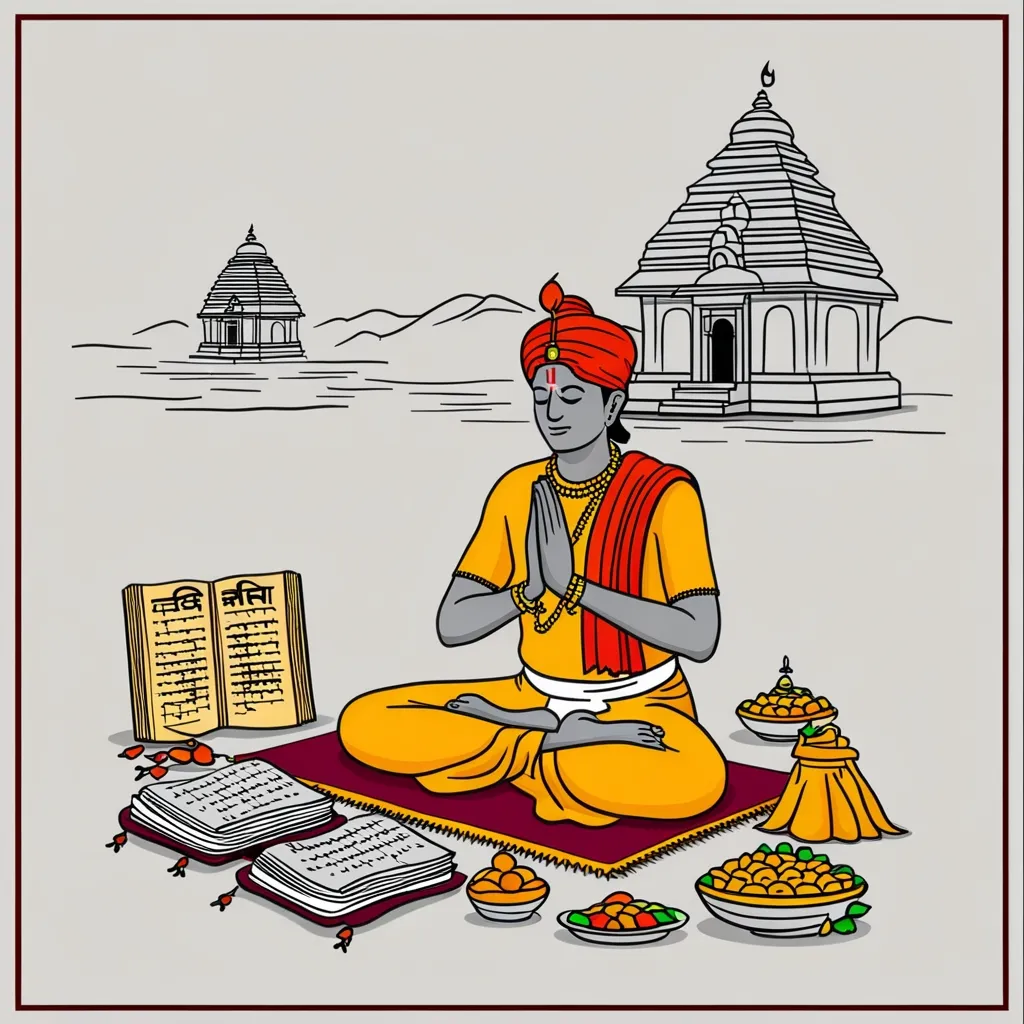
Bhuh is the earth. Not just soil and rock, but everything physical — your body, your coffee cup, your phone, the chair you’re sitting on. This is the waking world, the one you measure, touch, argue about, and pay bills in. The Vedas call this the realm of the gross body and the waking state.
Here’s what’s interesting though. Most spiritual traditions — Eastern and Western alike — tend to treat the physical world as a problem to be solved or an illusion to be escaped. The Vedas don’t do that. Bhuh is honored as the foundation. You don’t transcend it by rejecting it. You start here, fully, before you can go anywhere else.
“The earth is not a dead thing. It is the altar upon which all of life’s rituals are performed.” — Rigveda
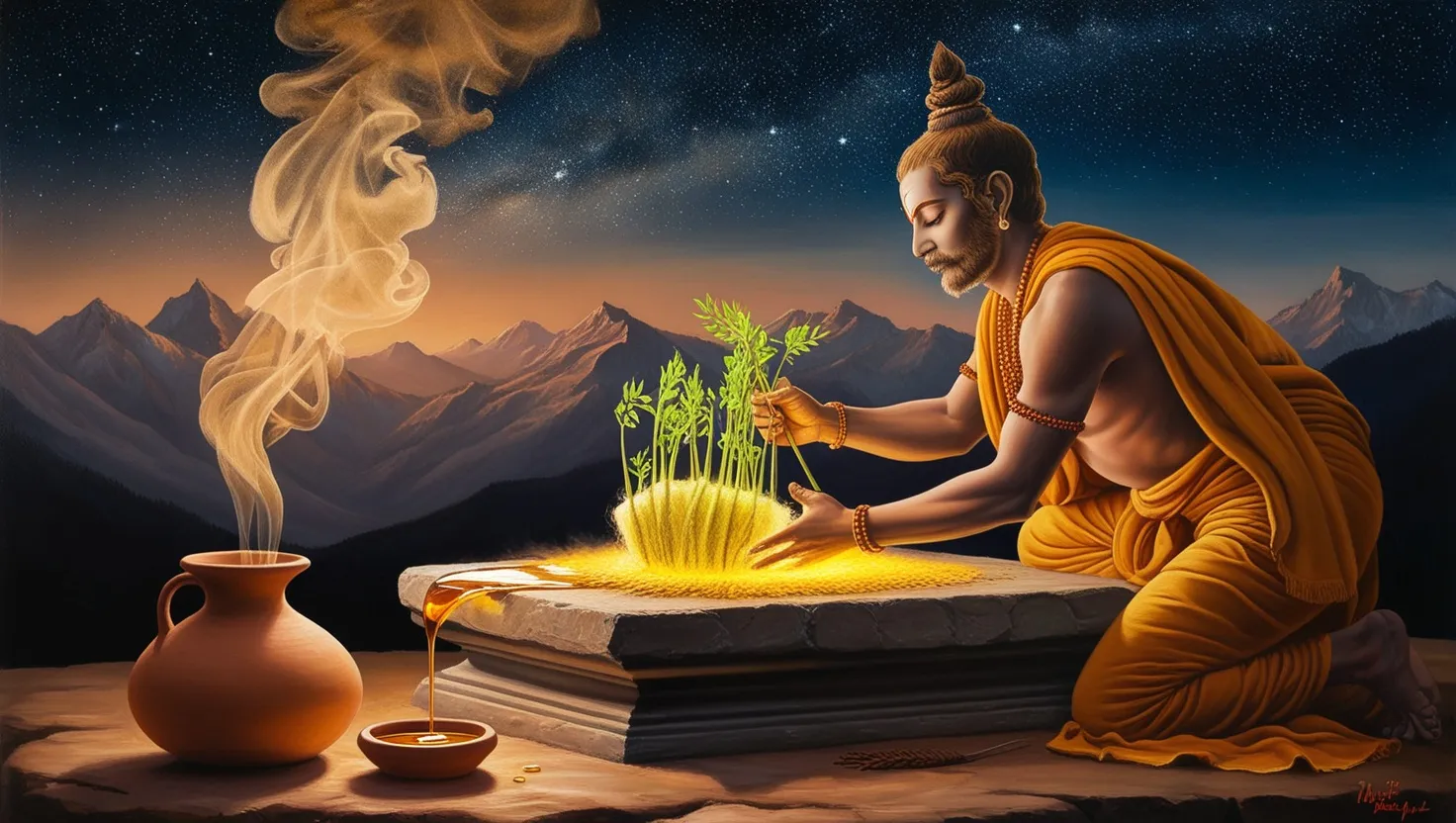
Think about the Vedic rituals around agriculture, seasonal cycles, and household duties. All of that belongs to Bhuh. There was no shame in being earthy, practical, and grounded. The person who tends their home and family with full attention is just as spiritually engaged as the monk on a mountain. At least, that’s what the seers thought.
So ask yourself honestly — are you actually present in your own Bhuh? Or are you physically here but mentally somewhere else entirely?
The Second World: Bhuvah — The World You Can’t Touch
Now things get interesting. Bhuvah sits between the earth and heaven. The Vedas describe it as the atmospheric realm — the wind, the breath, the space between. But psychologically, it maps onto something very familiar: your inner life. Your thoughts, your dreams, your emotions, your imagination.
Here’s the part most people miss. The Vedic seers were not speaking metaphorically when they called this a world. They genuinely believed — and their framework supports this — that the mental and emotional dimensions of experience occupy a real space. Not a physical space you can point to, but a subtle space that is just as real, operating by its own laws.
This is the domain of Prana, the life force. Breath is the bridge between body and mind, and that’s not accidental. When you’re anxious, your breath tightens. When you’re calm, it expands. The subtle body responds before the physical body does. The Vedic healers worked here long before anyone invented psychology.
“Between stimulus and response there is a space. In that space is our power to choose our response.” — Viktor Frankl
That space Frankl described? That’s Bhuvah territory. It’s where symbols arise in dreams, where grief lives before it becomes tears, where creativity sparks before it becomes action. The Vedic tradition understood that ignoring this middle world is how people get lost — either trapped in pure materialism or floating in spiritual fantasy with no emotional intelligence to anchor them.
Do you know when you’ve crossed from the physical world into the subtle one? Most people don’t. The shift happens constantly, and being able to notice it is an early form of self-knowledge the Vedas considered genuinely important.
The Third World: Svah — Where Thought Goes Quiet
Svah is the heavenly realm. But don’t picture clouds and harps. The Vedic understanding of heaven is far less literal and far more interesting. Svah corresponds to a state of consciousness — specifically, deep dreamless sleep. The state where the chatter stops, where you are aware of nothing in particular, and yet when you wake, you feel genuinely restored.
The Vedas identify this with the causal body — the field of pure potentiality from which all experience arises. Light, clarity, being without content. Most of us only reach Svah accidentally, in sleep, in moments of profound peace, occasionally in meditation.
“In deep sleep the soul gathers itself back to its source as rivers return to the sea.” — Brihadaranyaka Upanishad
What does pure potential feel like? It feels like the moment just before you think of something. The silence before the song. The Vedic seers considered this the closest most people get to the true self — not because it’s the destination, but because it’s the cleanest glimpse of what lies beneath all the noise.
The Fourth That Contains All Three
Here is where the Vedic system becomes genuinely startling. Beyond Bhuh, Bhuvah, and Svah lies something the texts call Turiyam — the fourth. Not a fourth world, but the ground from which all three emerge. Pure witnessing awareness that does not sleep, does not dream, does not wake, but is present through all of it.
The Mandukya Upanishad makes this its central teaching. Turiyam is not a mystical reward for the spiritually advanced. It is always already here. You are reading these words in it. You just haven’t noticed it yet because you’ve been watching the movie instead of looking for the projector.
“You are not a drop in the ocean. You are the entire ocean in a drop.” — Rumi
The three worlds are the movie. Turiyam is the screen. The screen doesn’t fight the images or get confused by them. It simply holds them, unchanged.
Why This Actually Matters
Here’s the practical part, and it’s simpler than you might expect.
Most of us live stuck in one of three familiar failure modes. The first is total immersion in Bhuh — grinding through tasks, obsessed with outcomes, measuring everything, unable to feel or reflect. The second is getting lost in Bhuvah — overthinking, drowning in emotion, living in your head, disconnected from physical reality. The third is premature Svah-chasing — trying to transcend everything before doing the work of integration, which tends to produce spiritual bypassing dressed up as wisdom.
The Vedic teaching is clean: you move through the worlds in order, and you don’t skip steps. Ground first, then feel, then reflect, then witness. A person who can do all four fluidly — who can fix the car, cry when grief comes, sit with a hard question, and find the stillness beneath it all — that person is doing what the Vedas consider genuine human maturation.
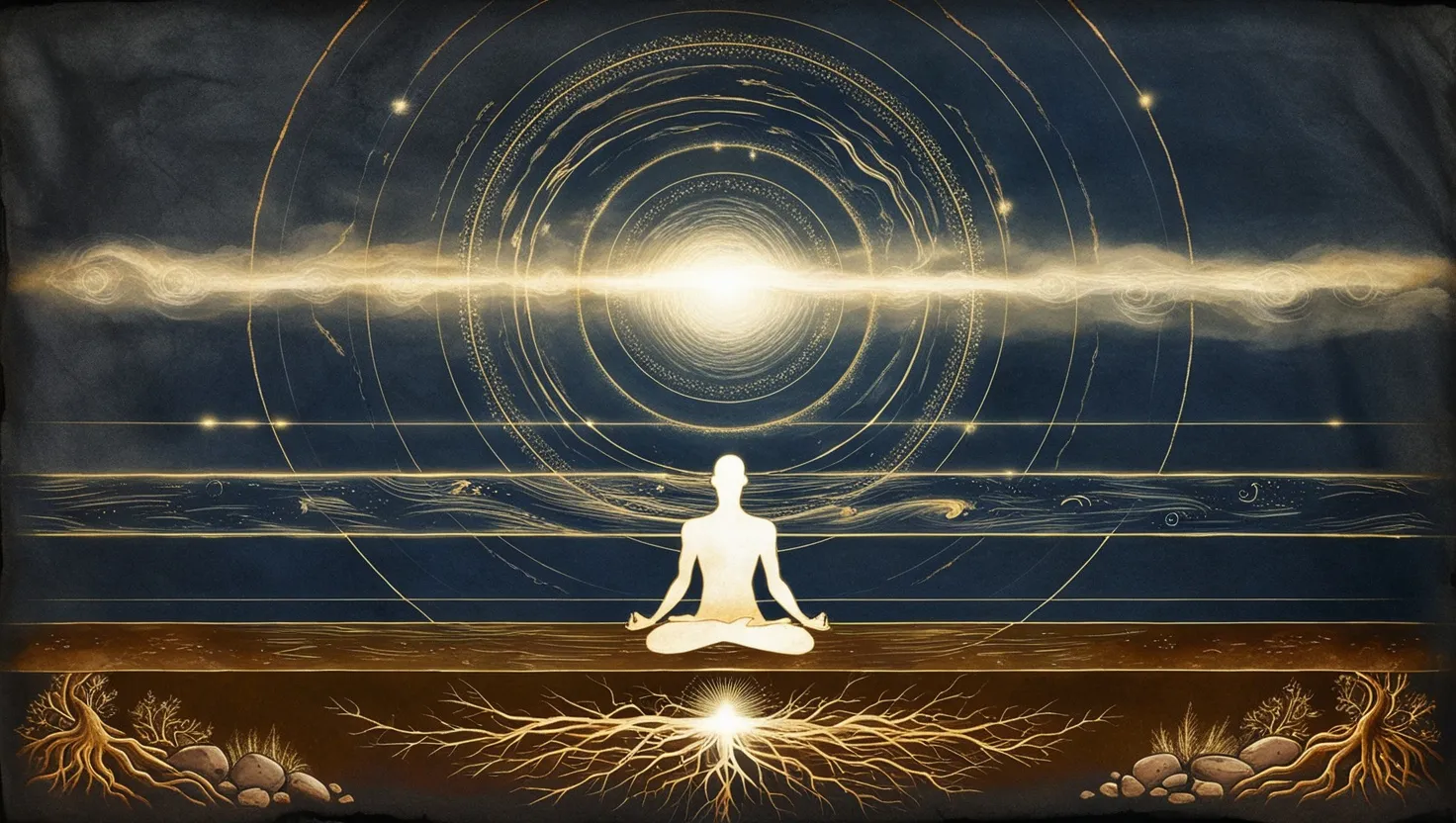
The human body itself reflects this architecture. The physical body is Bhuh. The subtle body of breath and emotion is Bhuvah. The causal body of deep rest and pure potential is Svah. Meditation, as the Vedic tradition taught it, was not an escape from the body. It was a systematic tour through all three layers, layer by layer, until you knew each one clearly enough to see through all of them.
One Simple Practice
You don’t need Sanskrit to work with this framework. Tonight, before you sleep, try this. Spend two minutes simply noticing your physical body — where it touches the bed, the weight of your limbs, the rhythm of your breath. That’s Bhuh. Then spend two minutes noticing your thoughts and feelings without following them. Just watch them move. That’s Bhuvah. Then, as you drift toward sleep, stop trying to direct anything. Let awareness rest in itself. That edge between waking and sleep, where thought fades but awareness remains for just a moment — that’s the doorway to Svah.
“All of man’s difficulties are caused by his inability to sit, quietly, in a room by himself.” — Blaise Pascal
The three worlds are not mythology. They are a map of what happens in every human being, every single day. The Vedic seers simply had the patience to draw it out, name it carefully, and hand it forward across thousands of years, waiting for someone to actually look at it.
You’re looking at it now. That’s a start.