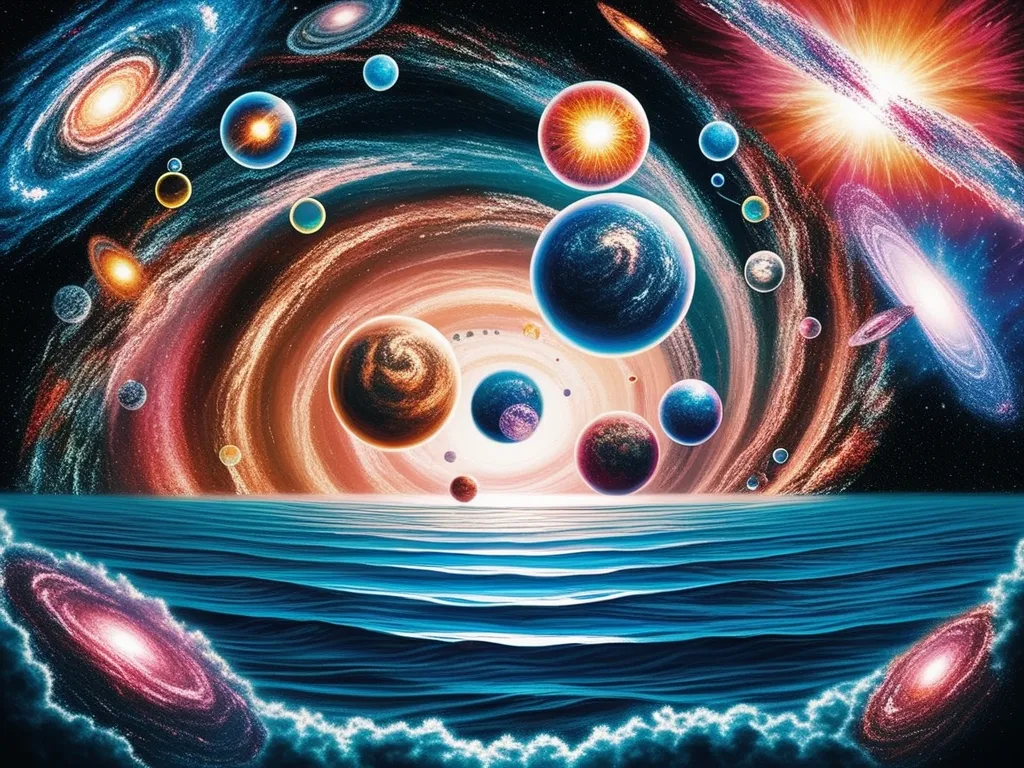
In the fascinating world of Hinduism, time isn’t just a clock ticking away; it’s a grand, cosmic dance. The ancient Vedic world didn’t see time as a straight line from past to future; instead, they painted it as a magnificent loop, where creation and destruction move in perfect harmony. This blend of microscopic and cosmic elements makes the Vedic concept of time truly unique and awe-inspiring.
Imagine starting at the tiniest level with what the Vedic scholars called “atomic time.” This isn’t about seconds or minutes but milliseconds barely noticeable to the human eye. They even had a term called truti, which breaks time down into 1/133,750th of a second. I mean, that’s mind-blowingly precise! The Vedic emphasis on such a granular level of time shows how advanced their understanding was, even compared to today’s technology.
Now, let’s zoom out from atoms to a more relatable scale - our human perception of time. In this system, a nimesha or the time it takes for you to blink, is the smallest unit. Stack up eighteen of these blinks, and you get a kashtha. Go further by grouping thirty kashthas, and you have a kala. Keep building, and after a series of kalas and muhurtas, one can structure a whole day and night. It’s like a well-choreographed dance, where each move has its part.
Step into the cosmic scale, and things get wild. Time here is mapped out in colossal spans. We’re talking about a kalpa, which is essentially one day for the creator god, Brahma, but for us, that’s 4.32 billion years. I can’t even wrap my head around that. This kalpa splits into smaller chunks called manvantaras, and each manvantara has 71 cycles of four distinct ages. These ages, from the golden Satya Yuga to the current iron Kali Yuga, show human civilization’s moral and spiritual journey over millions of years. It’s a bit like watching the fall and rise of empires through a divine lens.
All these ages and cycles aren’t just a fancy way of tracking years. They’re intertwined with cosmic events and societal stages. For instance, Satya Yuga is the era of truth, and humanity’s operating at its best. On the flip side, Kali Yuga, the age we’re in now, is seen as degenerate, marked by moral decline.
Let’s talk about the nitty-gritty of the creation and destruction cycles. Each day and night of Brahma, spanning those hefty 4.32 billion years, symbolizes the birth, growth, and dissolution of the universe. Think of it as a cosmic heartbeat. During Brahma’s day, the universe is awake and thriving; during his night, it’s time for everything to reset. This cycle repeats and repeats, aligning perfectly with the idea of an ever-revolving wheel of time.
When you come to think of it, this ancient Vedic view isn’t too far from modern scientific theories. Scientists today talk about the universe expanding and potentially contracting – a notion that feels eerily similar to these ancient cycles. Plus, the idea that time can warp or stretch based on your position in space sounds a lot like Einstein’s theories. It’s like ancient wisdom and modern science are shaking hands across the millennia.
But there’s more than just theory here. The Vedic system is practical, too, helping folks plan their daily routines and rituals meticulously. Time units such as muhurtas and kalas are not just abstract concepts but play a part in daily life. Whether figuring out the right time for a ceremony or starting a new venture, this ancient system offers a structured yet flexible approach.
The cultural depth of these time concepts is extraordinary. They encourage living in sync with nature’s cycles, fostering a mindset where every end is a chance for a fresh start. This cyclical view of time, emphasizing renewal and sustainability, offers invaluable lessons, especially in today’s fast-paced, linear-oriented world.
To wrap it up, the Vedic system of time is a beautiful patchwork quilt woven from the smallest particles to the vast reaches of the cosmos. It’s a profound mix of scientific sharpness and spiritual depth that feels surprisingly relevant today. In a world constantly buzzing with change, these ancient teachings gently nudge us to appreciate the cyclical pattern of existence, urging us to live in tune with the universal rhythm.
Reflecting on these millennia-old concepts in our modern lives can help ground us. It gives a broader view of where we fit in the grand scheme of things, encouraging actions that are responsible and in harmony with nature. So, maybe the ancient Vedic time cycles aren’t just dusty old ideas but might be the wisdom we need to build a balanced future.