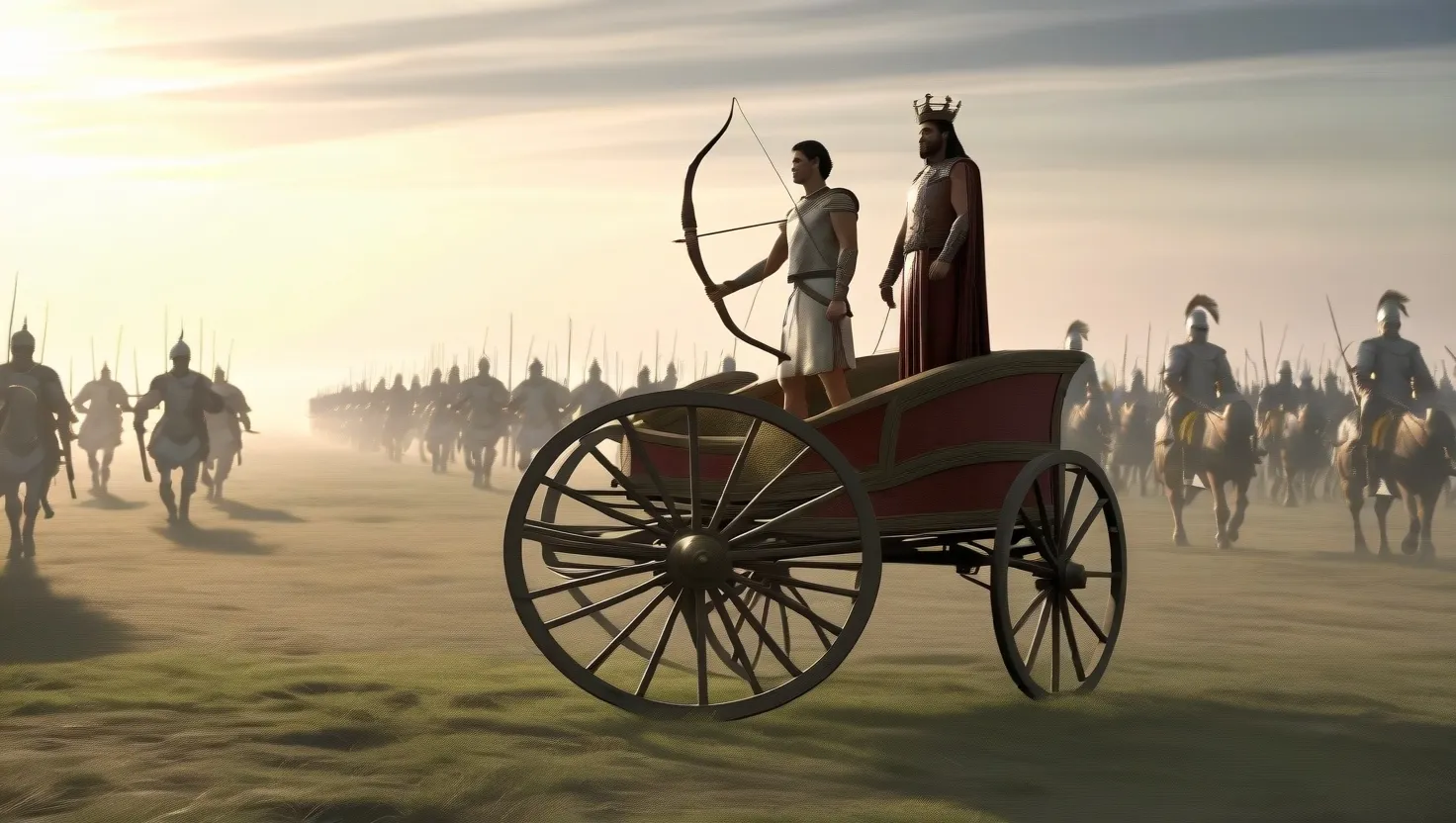
Curses in the Mahabharata look simple on the surface: someone gets angry, says harsh words, and something bad happens later. But if we look closely, they work more like a very strict cosmic rule book than like random shouting. They turn small personal mistakes into huge turning points for kingdoms, families, and even entire ages of history.
Let me walk you through this slowly, as if we are both sitting with the story for the first time, and I will keep asking you questions so you can test each idea in your own mind.
When King Pandu goes hunting and shoots the sage Kindama and his wife in the form of deer, it feels at first like a simple accident. People still say, “He didn’t mean it, so why such a harsh curse?” But in this epic world, intention is only one part of the equation. The other part is power and responsibility. A king’s arrow is not just a hunter’s arrow; it carries the weight of the throne. So the curse that follows—that Pandu will die if he approaches his wives with desire—does not just punish a mistake; it cuts straight into his role as a husband, father, and king.
Ask yourself: why does the curse hit him exactly where it hurts most, his ability to have children in a normal way?
By blocking his physical union with his wives, the story is forced to bring in niyoga, the special method by which the Pandavas are born. This is not just a strange detail. It quietly turns a bedroom problem into a royal crisis. Because the sons are born in an unusual way, questions of “real” fatherhood, legitimacy, and inheritance become sharper. One private curse becomes the seed of a public war.
This is one of the first patterns we see: a curse does not simply give pain; it rearranges the map of the story. It takes a moment of weakness and stretches it out over generations.
There is also a kind of poetic accuracy to Kindama’s words. Pandu killed a couple united in intimacy; in return he loses the right to enjoy intimacy with his own wives. The action and the result mirror each other very closely. In simple terms, the curse says: “You broke that sacred space, so your own sacred space will never be whole.” It is not just anger; it is a kind of rough cosmic math.
Let me ask you another question: if you knew that any careless act of yours would be paid back with this kind of perfect echo, would you still treat “small” wrongs as small?
Move back a little in the epic’s timeline and we find Shakuntala and King Dushyanta. Here the hurt is not physical harm; it is forgotten love. When he fails to recognize her later, her pain turns into a spoken wish that their son, Bharata, will not recognize his father either. This is more than a couple’s quarrel. It sets up a pattern: when a man in power forgets, denies, or erases a woman’s dignity, the result does not stay inside the home. It spills into succession, royal lines, and the very naming of the land.
Shakuntala’s words are interesting because they come from hurt but also from truth. She is not lying to get revenge; she is pointing to the gap between Dushyanta’s promises and his present behavior. In this epic world, when pain is tied to truth, speech becomes very heavy. It is almost like the universe says: “If you speak from a place of clean hurt, I will treat your words like law.”
That idea becomes much bigger when we meet Gandhari.
Gandhari spends her whole adult life tied to a vow she did not fully choose: she blinds herself with cloth so she can share her blind husband’s condition. She does everything a wife and mother is supposed to do, at the absolute maximum level. And yet, one by one, she watches all her hundred sons die in the war.
At that point, what should a mother like her do with that much grief? Stay silent? Collapse? In the Mahabharata, she turns that grief into a curse on Krishna and his clan. She says that just as her own family died through hatred and infighting, so will his. She also says he will die alone, with no one to help him. The most striking part is that Krishna, who is seen as an incarnation of the divine, does not cancel this curse. He accepts it.
Why would a god accept a curse?
Here we touch a deeper idea: some curses in the Mahabharata are not random punishments; they are spoken forms of a karmic bill that is already due. Gandhari’s words do not create a brand new destiny; they reveal where the river was already flowing. Krishna’s clan has grown proud, violent, and careless. Her curse is like a judge reading out a sentence that the evidence has already written.
Notice also how similar the curse is to the crime. Her sons die in a huge war between cousins. Krishna’s clan dies in a drunken fight among themselves. She lost everything; he loses everything. In very simple terms, the epic keeps pushing this one message: “What you do will come back in the same shape, sometimes through the mouth of someone you have deeply wronged.”
Here is where I want you to pause and ask yourself: in your own life, how often do you speak from pain, and how often from simple irritation? If your worst words carried real power, would you still say them?
Let us move to Karna, because his story shows another side of curses: they often fall not on obviously cruel people but on people who live in the grey zone—honorable in many ways, but cracked by pride or insecurity.
Karna lies to Parashurama about his birth, pretending to be a Brahmin so he can receive special training in weapons. The lie succeeds; he gets the knowledge. But when his teacher later discovers the truth, he curses Karna so that this knowledge will fail him at the very moment he needs it most.
This is extremely sharp design. The curse does not remove what Karna loves; it makes it unreliable. Imagine preparing your whole life for one exam, and on that day you forget everything. That is what happens to him in battle. The epic is basically saying: “If you build your greatness on a lie, that greatness will crack exactly when you lean on it.”
Then there is the Brahmin whose cow Karna kills by mistake. Out of helpless anger, the man curses that Karna’s chariot wheel will sink during his crucial fight. Again, the result matches the act in a strangely exact way. Karna killed a gentle animal that was tied and could not move away; later, he becomes that stuck, helpless figure on the battlefield, trapped by his sunken chariot, unable to defend himself properly.
Here you can see another pattern: curses in this epic often hit you at the junction of your strength and your weak choice. They do not throw a random stone from the sky. They turn your own cracks into the doorway through which fate walks in.
Do you notice something else here? The people who curse are rarely the strongest players in the outer sense. A travelling sage, a poor Brahmin with a single cow, a woman whose husband has ignored her, a mother who has lost her sons—these are not kings on thrones. Yet when they speak from a place of moral injury, their words shape the entire story.
It is almost as if the Mahabharata is quietly saying: “Do not measure power only by weapons or crowns. A wounded conscience has its own kind of force.”
Let me bring in a famous line that suits this world very well:
“Words are, in my not-so-humble opinion, our most inexhaustible source of magic.”
This comes from a modern fantasy story, not from the Mahabharata, but the idea fits perfectly. In this epic, words are not cheap. A blessing or a curse is treated like a real object that cannot be taken back easily once released.
You might ask: are curses always personal? Is it always one person hurting another and then getting hit back through some verbal missile?
The epic gives us at least one much larger example. When the earth herself, personified as a goddess, complains that the burden of human wrong-doing is too heavy, her cry leads to a plan: the gods will be born as humans, and a great war will clean the slate. Here, the “curse” is not shouted in anger. It is more like a systemic complaint: “This world is out of balance; do something.”
This turns the whole Kurukshetra war into a kind of huge reset button. Not because some god woke up cranky one day, but because the total weight of human choices had bent reality too far. You could say the war is the visible battle, and the earth’s earlier cry is the invisible curse that makes such a battle inevitable.
Have you ever seen this pattern on a smaller scale in real life? A company that cuts corners slowly, year after year, and then one day collapses in a scandal? A family that hides problems for generations until one explosive event forces everything out into the open? That “explosive event” often feels like a curse, but it is usually just the bill for long-term behavior.
Even small, offhand words matter in this world. Take Draupadi laughing at Duryodhana in the palace of illusions. When he slips in the hall and she comments that “the son of a blind man is blind,” it is not framed as a formal curse. It is a sarcastic line, a brief stab of pride. But some tellings suggest that this moment contributes—at least symbolically—to her later humiliation in the court.
This does not mean the epic “blames” her for the abuse she suffers. Instead, it highlights something else: sharp words, especially those that insult someone’s basic condition (like a father’s blindness), create lingering bitterness. They stay inside the other person like a seed. Later, that seed may grow into revenge.
So even when we are not formally cursing, our speech can still function like a softer version of one. A curse in this story is not always a shout with raised hands; sometimes it is a single line said in pride, which comes back years later in a much harsher form.
Let me ask you: how many “jokes” have you made that could stay burning inside the other person for a long time? If those jokes had the power to shape your shared future, would you still find them funny?
There is another key point most people miss. Many curses in the Mahabharata come after someone breaks a limit knowingly. Karna knows he is lying to Parashurama. Pandu has been warned about the rules of hunting but still acts impulsively. Often, the person who is cursed has crossed a line that they themselves understand, at least at some level. The curse does not fall on innocent ignorance; it lands where there was some awareness, even if pushed aside.
That is why these imprecations feel less like magic spells and more like moral physics. If you throw a stone up, it will come down. If you cross certain lines with full awareness, there will be some form of response. This is the epic’s way of making ethics feel as solid as gravity.
Let me share another line that fits this idea:
“We are our choices.”
This quote, from a modern philosopher, could describe almost every major cursed figure in the Mahabharata. Pandu, Karna, even parts of Krishna’s own clan—they are not random victims. They are people whose earlier choices give curses a place to land.
Now, you might be thinking: “All this is very grand and moral, but what does it do for me personally?”
Here is one simple application. Instead of treating curses in the Mahabharata as superstition, think of them as a visual, dramatic way of showing how actions echo. The epic has no interest in letting an action be just a moment. It stretches each deed across time so we can see its full effect. The curse is that stretch.
So when you and I speak, decide, or act, we can quietly ask: “If this moment were written as a Mahabharata episode, and someone had the power to curse or bless me based on this exact behavior, what would their words be?” It is a simple mental game, but it forces us to see even tiny acts as part of a chain, not as disposable.
There is one more subtle angle. Curses here also reveal character. How a person reacts to a curse tells us what they truly are inside. Karna accepts his fate and continues to fight with courage. Gandhari, despite her curse, does not turn into a cartoon villain; she stays a mother burned by loss. Krishna hears his own future doom and still continues his role in the war.
The epic seems to say: destiny may press you from outside, but your inner response still matters. You cannot always choose what comes to you, but you can choose how you carry it.
So I want to leave you with a very simple, almost childlike question: if your anger, your grief, or your hurt could become a force that shaped the fate of others, how careful would you be with your words?
In the Mahabharata, curses are that force. They are not just loud statements. They are the way the story shows that the universe is listening—and that nothing, not even a single careless arrow or a casual insult, is truly small.