Once upon a time, in the world of the Mahabharata, the Pandavas found themselves caught in a web of deceit spun by their jealous cousin Duryodhana. Driven by a burning desire for power, Duryodhana pulled a fast one, convincing his father, the blind king Dhritarashtra, to send the Pandavas to Varanavata, under the innocent guise of attending a festival.
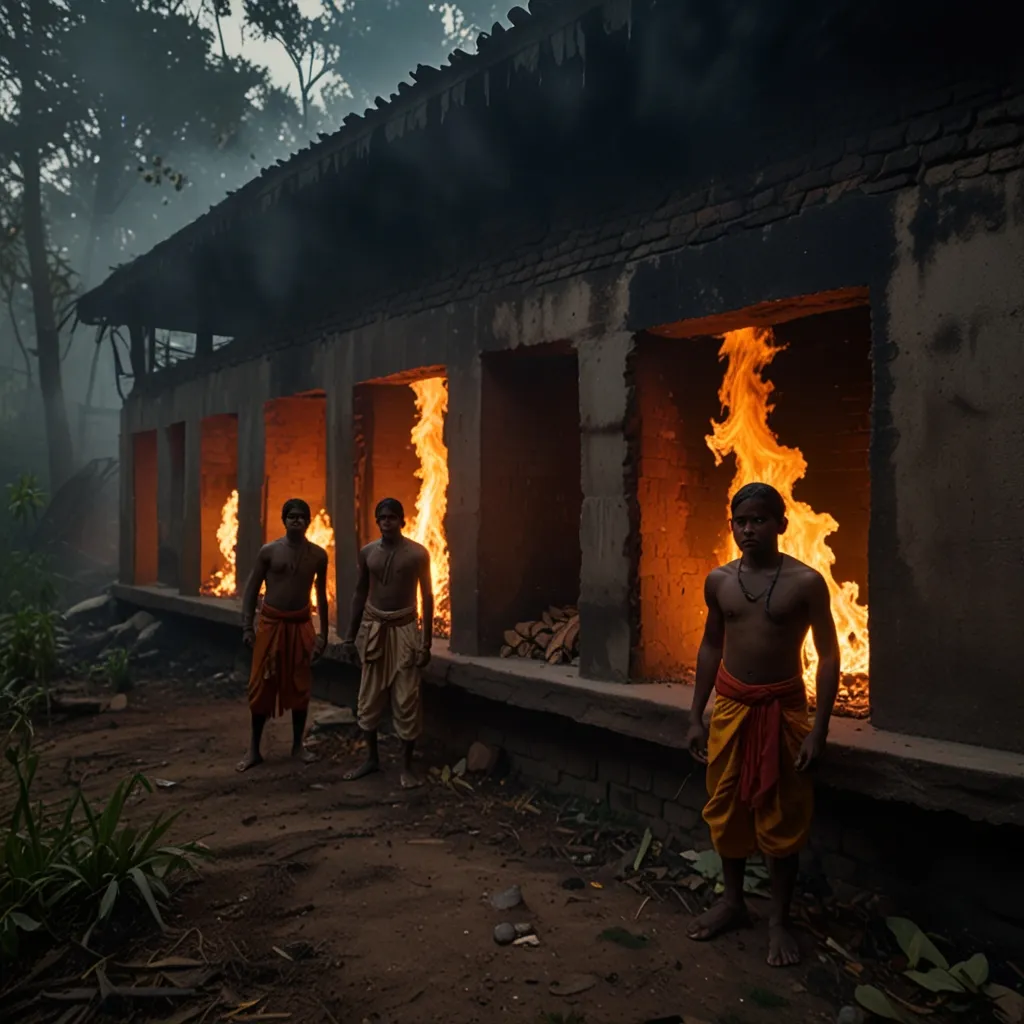
But Duryodhana was no saint. He’d had a treacherous house built for them, using highly flammable materials like lac, hemp, and resin. This House of Lac, or Lakshagriha, was nothing but a fiery trap meant to incinerate the Pandavas and their mother, Kunti, alive.
The Pandavas, upon their arrival in Varanavata, were met with grand celebrations. It was a festival alright, but one hiding sinister intentions. Vidura, their wise uncle, wasn’t buying Duryodhana’s friendliness. He smelled something fishy and gave Yudhishthira a heads-up. The warning was cryptic, yet Yudhishthira, sharp as a tack, grasped the imminent danger. They quickly realized their new abode was a death trap.
As the eldest, Yudhishthira took it upon himself to inspect the house. The strong smell of lac and ghee hit him hard. He confided in Bhima, pointing out that their enemies had constructed the house with flammable materials—hemp, resin, straw, and bamboos—all soaked in ghee. Purochana, their enemy’s puppet, was there too, waiting for the moment to strike.
Bhima suggested they move to a different house. But Yudhishthira knew better; leaving might raise suspicion and lead them straight into another trap. They decided to stay, all the while keeping their guard up and scheming an escape plan. Vidura, their secret ally, played his part by sending a skilled miner to help them dig a tunnel. The tunnel snaked from the middle of the house out to near the river Ganga, offering a potential escape route.
One evening, they decided to throw a grand celebration in the House of Lac, pulling the people of the town into a swirl of festivities. Even Purochana dropped his guard, got drunk, and fell into a drunken stupor. Along came a nishada woman and her five sons seeking charity; they too succumbed to the party spirit and passed out in a secluded corner of the mansion.
As luck would have it, a strong wind began to howl that night. Yudhishthira saw this as the moment of truth. He ordered Bhima to torch the house, starting from where Purochana lay. The fire roared to life, spreading rapidly and swallowing the house in a hellish blaze. The Pandavas, along with Kunti, dashed through the secret tunnel, emerging safely by the riverbank.
The townspeople woke in a panic, rushing to the inferno consuming what they thought was the Pandavas’ abode. They stumbled upon the charred remains of Purochana and the nishada family, mistaking them for the Pandavas. Heartbreak flooded Varanavata as they mourned the presumed death of their princes.
Dhritarashtra and Duryodhana, upon hearing the news, believed their scheme had succeeded. They even arranged the cremation of what they believed were the Pandavas’ bodies, convinced their rivals were no more.
But little did they know, the Pandavas had outsmarted them. They were alive, on the run, but very much kicking, ready to face the wild world ahead of them. This daring escape from the House of Lac was just the beginning of their saga, setting the scene for future battles, courage, and relentless pursuit of justice in the ruthlessly complex terrain of ancient India.