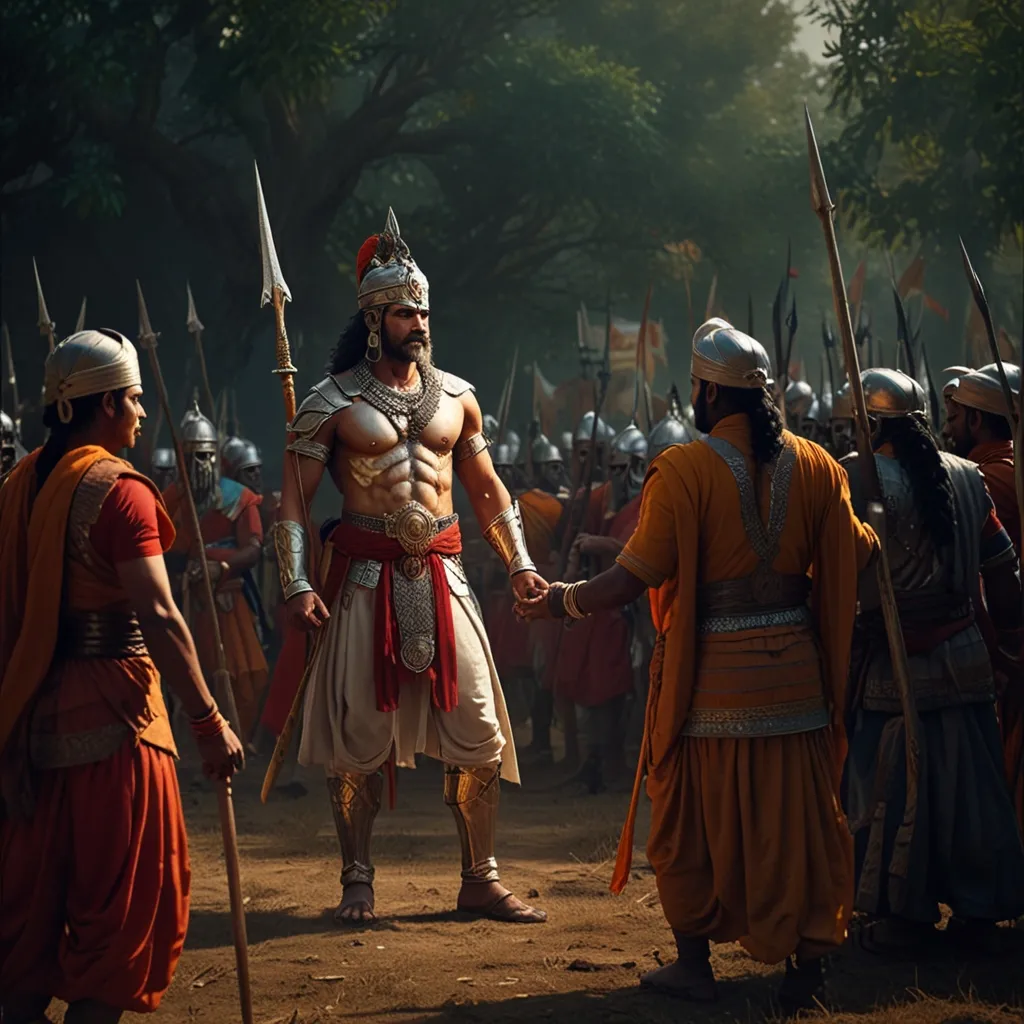
In the grand tapestry of the Mahabharata, Pandu’s story stands out as one of the most dramatic and poignant threads. Imagine being a powerful king, only to have your life flipped upside down by a single act that draws a devastating curse. That’s exactly what happens to Pandu, a guy known for his bravery and skill in battle, but whose life tragically revolves around a fatal curse.
It all started on an ordinary hunting trip. Pandu, strong and boastful, was doing what he did best—aiming his arrows at wildlife in the forest. But this particular day, he stumbled upon a pair of deer in the middle of a private moment. Turns out, these weren’t just any deer. They were actually a sage named Kindama and his wife, transformed by magic for some mystical forest romance. Pandu, blissfully ignorant, lets his arrows fly—and boom, both deer drop dead.
With his dying breath, Kindama curses Pandu. This curse isn’t something light you laugh off; it’s a heavy burden. It dictates that if Pandu ever becomes intimate with his wives, he’ll die. Just like that, an accidental kill leads to a lifelong sentence. Pandu goes from being a mighty king to a man haunted by his own desires. Imagine wanting something so naturally human—love, children—but knowing it could be the end of you.
Torn between his desire for children and the dread of the curse, Pandu makes a choice few could imagine. He steps down from his throne, renounces the throne, and heads out to live like a hermit in the wilderness with his wives, Kunti and Madri. This isn’t a straightforward “let’s move to the countryside” decision; it’s laden with giving up immense power and prestige, all because he’s just too scared that fulfilling his desires will kill him.
But Pandu’s dilemma isn’t only physical; it’s deeply psychological, making his story all the more fascinating. Physical fitness doesn’t quite cut it when your mind is wrapped in fear. Try as he might, he can’t consummate his marriages, which complicates his feelings of manhood and power even further. His impotence isn’t just a result of the curse, but a symbol of the mental torment he endures.
The plot thickens with Kunti’s clever use of a mantra gifted by the sage Durvasa. This mantra has some serious divine power—it lets her summon gods to ask for children. With some heavenly help, she becomes mother to Yudhishthira, Bhima, and Arjuna. And thanks to a bit of sharing spirit, Madri uses the mantra too, giving birth to twins Nakula and Sahadeva. These five sons, famously known as the Pandavas, are central to the Mahabharata’s epic tale, playing key roles in the climactic battle of Kurukshetra.
Think of Pandu being so close to ending his torment, yet one fateful day, overcome by longing, he embraces Madri. This isn’t some fairy-tale happy ending though. True to the curse, Pandu dies right there in Madri’s arms. Maddened by grief and guilt, Madri ends her life on Pandu’s funeral pyre. It’s a tragic end, but it’s a poignant part of their story.
Pandu’s demise doesn’t end his influence. The Pandavas are still around, his legacy living through them. Raised by Kunti, acknowledged by their uncle, King Dhritarashtra, the Pandavas grow up with their Kaurava cousins. This complex sibling rivalry ultimately sets the stage for the great war of Kurukshetra. The war’s outcome shapes the future of the kingdom, making Pandu’s story a key piece in the epic puzzle.
Take a moment to think about what Pandu’s tale teaches us. It’s more than just the story of a man cursed for a mistake. It’s a reminder of how fragile human existence is, subject to forces and fate beyond our control, yet defined by our choices. Pandu’s story also spotlights the resilience and strong will of his family. His life and decisions, though tragic, are deeply interwoven with themes of destiny, duty, and the human psyche, which are central to the Mahabharata.
Now, imagine being part of this saga, weaving Pandu’s narrative into the larger epic of the Mahabharata. It’s not just about ancient folklore; it’s about understanding ourselves, our struggles, and the moral tightropes we walk in life. Pandu’s life may be marked by a curse, but it unfolds into a rich legacy carried by his sons, highlighting an eternal human tale of resilience, honor, and the unending battle between free will and fate.
So, take a moment to ponder Pandu’s remarkable journey. It’s a story that’s not just locked in ancient texts but echoes in our lives today. Whether grappling with unforeseen consequences of our actions or navigating the delicate balance between desire and duty, there’s a piece of Pandu’s journey in all of us.