How Hindu Cyclical Time Challenges Our Linear View of Life and Death
Discover how Hindu cyclical time transforms our understanding of existence through eternal cosmic cycles, yugas, and reincarnation. Learn to find peace in life's rhythms.
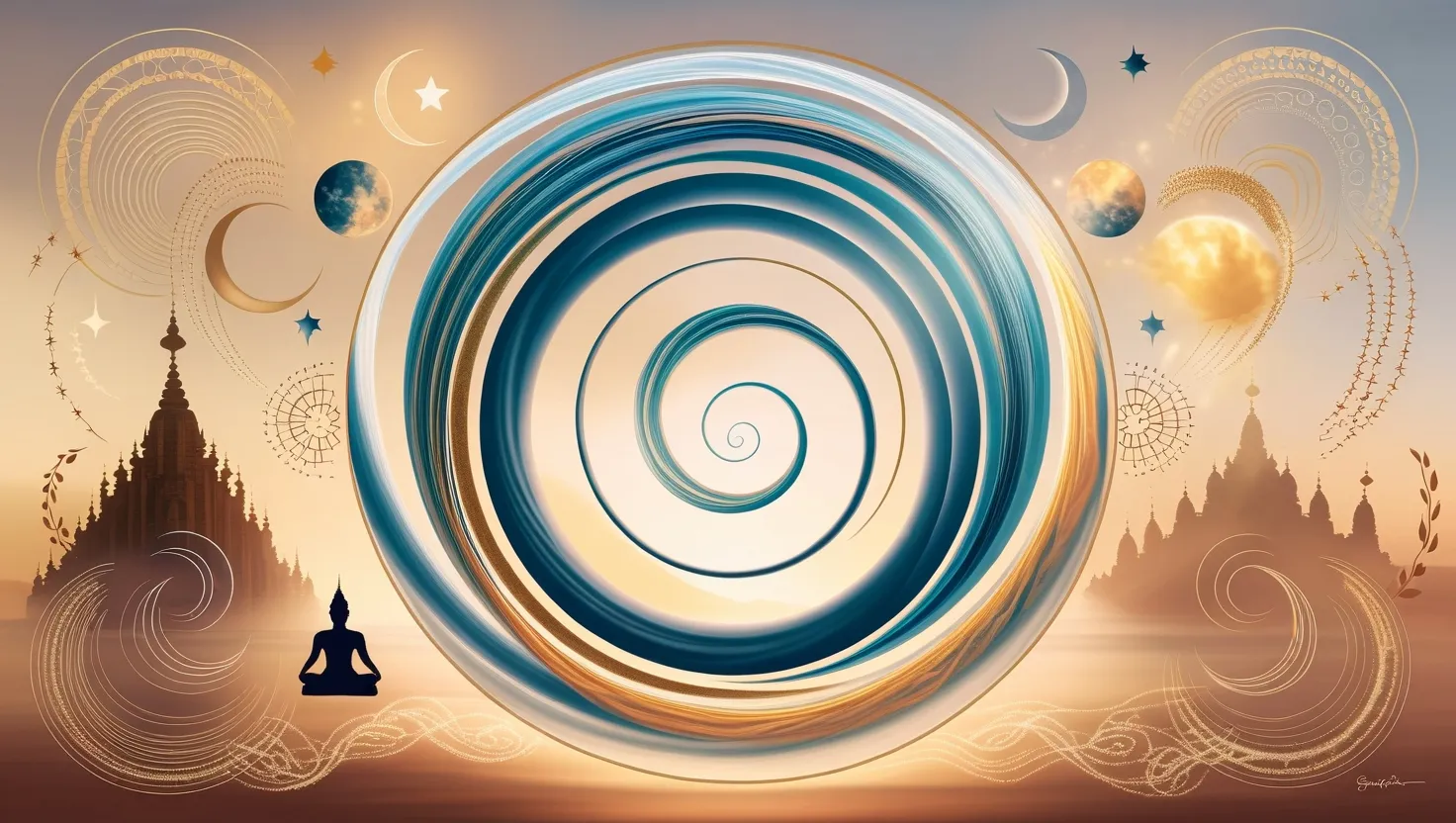
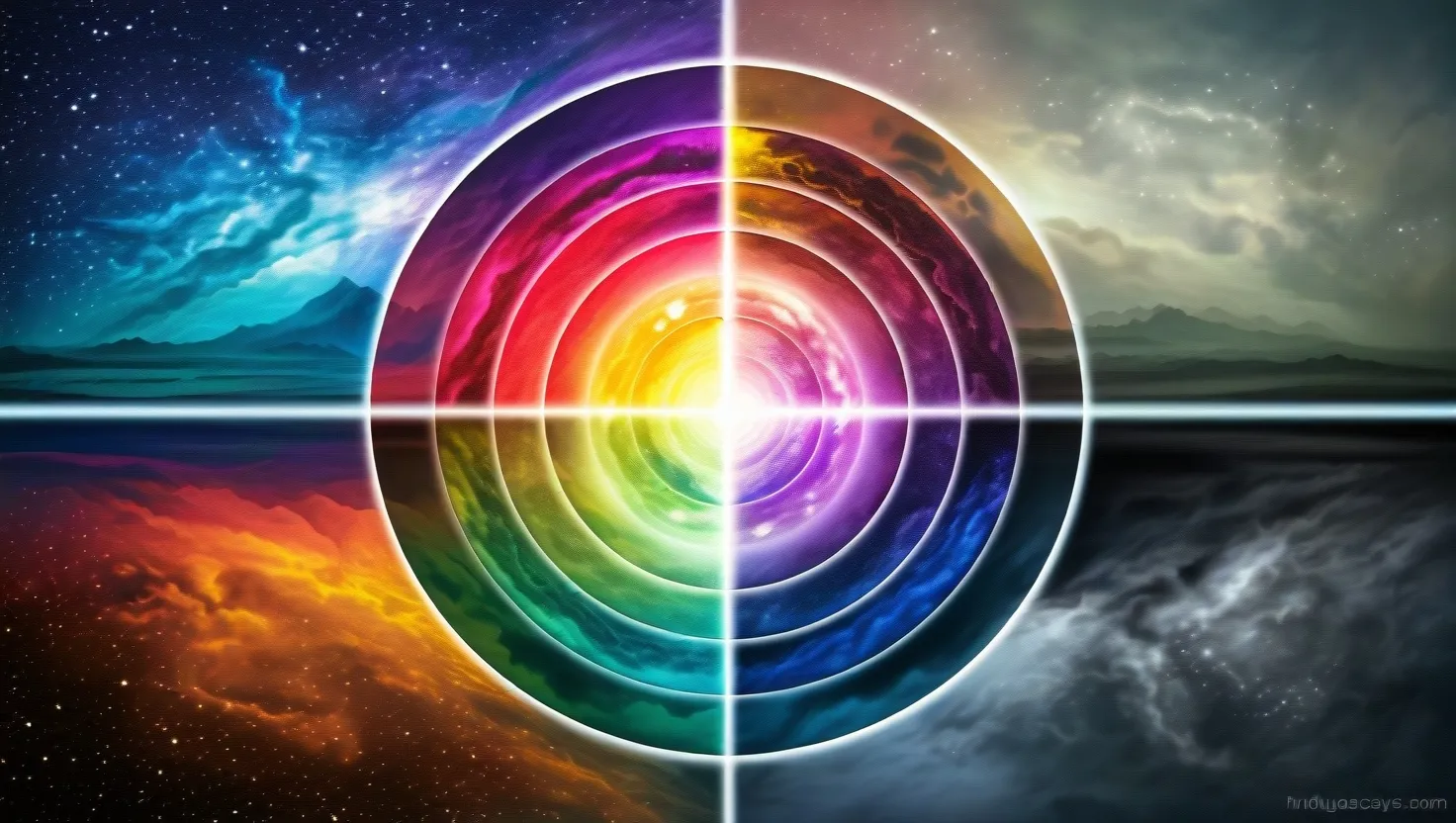
If I invite you to consider time as something more than ticking clocks and advancing calendars, how does your mind respond? In most of our daily lives, time seems to push us forward—a straight path from past to future, measured in deadlines and milestones. Yet, step into the world of Hindu cosmology, and the ground shifts beneath your feet. Here, time is not a straight line, but an endless cycle—a circle that holds together the universe’s dance of creation and dissolution, where every ending is also a beginning, and every moment participates in something far greater than itself.
“Time is a created thing. To say, ‘I don’t have time,’ is like saying, ‘I don’t want to.’” — Lao Tzu
Picture a clock with many hands, each moving at its own steady pace. There’s the sweep of seconds we feel by the beat of our hearts, but also the slow turning of yugas—vast epochs spanning hundreds of thousands, even millions of years. In the Hindu imagination, the universe breathes in and out across kalpas, which are days in the life of Brahma, the creator. Each kalpa witnesses cycles of birth, growth, decay, and eventual rebirth. What’s truly surprising is just how old these scales are: ancient Sanskrit texts set forth these immense cosmic timescales at a time when most of the world’s cultures saw history in much shorter terms.
Did you ever wonder what it would mean if your entire life was set within such a recurring cosmic pattern? This is not just abstract philosophy. For Hindus, these cycles are a living reality, shaping everything from how rituals are timed to how personal challenges are faced. Auspicious moments—called muhurtas—are carefully identified using precise astronomical observations. The lunar calendar dictates fasts like Ekadashi, associated with spiritual purification, while solar transitions like Makar Sankranti signal moments of renewal and cultural festivity. The year is not just a progression of dates; it’s a map of spiritual opportunities, each one distinct, each one recurring.
The Bhagavata Purana, a text revered for its sweeping vision of time, lays out four ages—yugas—that repeat over and over. Satya Yuga is a golden age of truth and peace; then comes Treta Yuga, when virtue begins to slip but ritual strengthens community; Dvapara Yuga brings further decline; and finally, Kali Yuga, the time we inhabit now, is marked by confusion, conflict, and spiritual forgetfulness. These aren’t just stories about the past. They are templates for understanding our present, with all its complexities.
“Yesterday is gone. Tomorrow has not yet come. We have only today. Let us begin.” — Mother Teresa
It might seem counterintuitive that, living in Kali Yuga—a time of apparent moral chaos—Hindu philosophy often feels optimistic. There’s a radical idea here: while Kali Yuga is seen as the most difficult age, it’s also described as the most spiritually accessible. Liberation, or moksha, is said to be more readily available to those who seek it sincerely, precisely because the outer world is filled with obstacles. Isn’t that a powerful way to find purpose in adversity?
Reincarnation—the idea that the soul is reborn across many lives—fits naturally within this cyclical model. Actions performed in one life ripple across many lives, reinforcing the importance of karma. If you don’t get it right this time, there’s always another chance. This long-term view softens the sting of disappointment and nurtures a certain patience. I’m often struck by how comforting it can be to see one’s struggles as fleeting, part of a much longer road of learning and growth. It’s a reminder that our journey is both personal and cosmic.
With every sunrise, an individual’s daily routine—dinacharya—becomes an echo of the universe’s own rhythms. Early morning, known as Brahma muhurta, is considered the most auspicious time for meditation and reflection, when the mind is naturally calm and receptive. Meals, work, rest—each is pegged to the movement of the sun and moon, creating a template for living in tune with natural energies. Even in simple acts, there is an invitation to mindfulness, a gentle challenge to make each moment sacred rather than mundane.
I find it fascinating how this cosmological vision percolates into practical life, especially in India’s villages and towns. Farmers often choose planting and harvesting times according to the moon’s phase. Families plan weddings or groundbreaking ceremonies only after consulting astrologers for the right muhurtas. Birth charts—kundalis—are still carefully prepared for newborns, mapping not just their stars but their very destinies. These practices are not mere superstition; for many, they are acts of aligning personal life with the larger cosmic play.
“Do not dwell in the past, do not dream of the future, concentrate the mind on the present moment.” — Buddha
I often ask myself: What could modern life gain from such a perspective? In a world obsessed with productivity and relentless growth, cyclical time offers a radical counterpoint. It suggests that rest, renewal, and even decline are not failures but necessary parts of the process. Corporations and organizations grappling with burnout and unsustainable work rhythms might learn from the idea that even the universe itself requires periodic dissolution and rest before it can begin anew.
Environmentalism, too, finds a deep resonance here. The notion that nature is continuously reborn, that nothing is wasted in the grand cycles of creation and destruction, challenges us to see sustainability not as a trendy initiative but a fundamental principle of existence. Ancient Hindu agricultural practices—like leaving fields fallow to regenerate—mirror these cycles, reinforcing humanity’s place within, not above, nature.
“Time is the wisest counselor of all.” — Pericles
There is also a psychological dimension worth considering. When you see your own life as a series of cycles—of health and illness, success and struggle, happiness and loss—it becomes easier to cultivate resilience. You know that no state is permanent, that change is the only constant. Even periods of darkness, like the legendary Kali Yuga, contain within them the seeds of renewal. I find this mindset both grounding and liberating.
In architecture and art, the influence is equally profound. Visit ancient temples across India, and you’ll notice how their inner sanctums are designed so that, on specific days each year, a ray of sunlight strikes the deity at dawn or sunset—cosmic events translated into physical form. The Indian national calendar, still lunisolar, is a testament to this living relationship with cosmic cycles. Festivals, too, are never fixed to a single date but shift each year with the rhythms of the moon and sun.
Let me pose a question. If you knew that time was an endless circle, and that your life would come around again, how would that influence your choices today? Would you live with more patience, more detachment, or perhaps with greater appreciation for each fleeting joy?
“We must use time wisely and forever realize that the time is always ripe to do right.” — Nelson Mandela
In daily speech, Indians often refer to favorable or unfavorable times—subha or asubha—when making decisions. It’s not just about luck or fate; it’s a way of recognizing that timing itself has a spiritual quality. This cultivates an attitude of humility, a willingness to wait for the right moment rather than forcibly bending the world to one’s will.
Yet, Hindu time concepts are not a rejection of action or progress. Rather, they frame action as part of a much broader, ongoing story. Ethics, too, are cyclical: what is right for one age might not be right for another, and wisdom lies in adapting to the times. The Bhagavad Gita, for example, urges warriors to fight when it is their duty but also to let go of the desire for particular outcomes. It’s a subtle, nuanced worldview—neither fatalistic nor blindly optimistic.
I’d argue that the real legacy of this philosophy is the invitation it offers to see time as a teacher, not an enemy. Time is not something to be fought or outrun—it’s a guide, a context for learning what can only be learned through the passage of days, years, and lifetimes. Even endings—whether of relationships, careers, or lives—are not to be feared, for they are simply the beginning of another cycle, another opportunity to grow.
So, as you reflect on your next hour, your next day, your next big decision, try viewing time not as a straight road but as a living circle. Notice where you are in your personal cycle. Are you in a phase of creation, preservation, or perhaps, dissolution? What lessons does this moment contain? How can you honor the cycles within and around you?
“Time isn’t the main thing. It’s the only thing.” — Miles Davis
In the end, the wisdom of Hindu cyclical time offers a gentle but profound challenge: to live each day as if it is both utterly unique and yet part of an eternal rhythm. When we see existence with this lens, we discover that the ordinary is always infused with the extraordinary, and that in every fleeting instant, eternity is quietly waiting to be found.